
01
The Reality
Building a house looks like one job, but in the field it is lived as many jobs running side by side. The homeowner imagines the finished result, architects and designers draw the plans, contractors and builders sequence the work, material suppliers keep goods flowing. Each holds a slightly different picture of the same building.
As long as those pictures stay aligned, work flows. The moment one party changes something without the others understanding it, the small gap spreads: schedules shift, costs are questioned, work is redone. This is the reality we chose to study first, before discussing any solution.
02
Observation
When information moves from one participant to the next, interpretation moves with it. Plan drawings are read differently by builders; a supplier’s verbal promise is recorded differently by the contractor; the homeowner’s unwritten expectations never enter the plan at all. Not because anyone acts in bad faith, but because there is no shared truth held by all parties.
This pattern repeats across different projects wearing different faces. We record it as an observation, not a verdict: each participant acts rationally according to the picture they hold, and problems emerge in the gaps between those pictures.
03 — Symptoms
04
Deconstruction
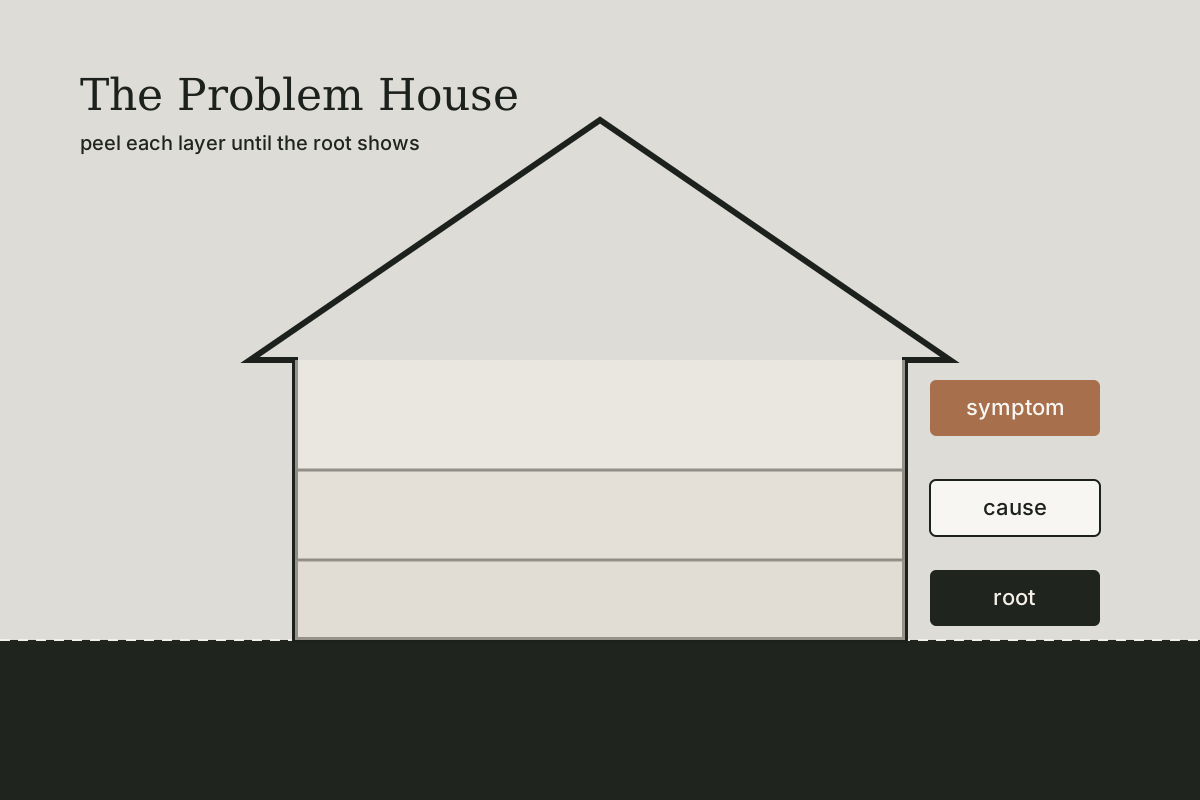
The symptoms vary: delays, cost uncertainty, rework, conflict between parties, loss of trust. But symptoms are not roots. When we deconstruct them, every symptom points to the same structure: there is no continuity of information from the initial picture to the standing building.
Each participant keeps their own records in their own format. There are no shared primitives — what a room is, what a change is, what a commitment is — meaning the same thing to everyone. So every handoff becomes a point where meaning can shift undetected.
05 — Fundamental Problem
There is no continuity of information or shared primitives across participants (homeowner, design, builders, supply), so every handoff becomes a point where meaning shifts undetected.
06 — Truth to Preserve
The same picture of what is being built — its meaning must stay consistent for every participant at every stage.
07
Model
To understand this problem we model it as relationships between participants, not as a task list. Every information handoff is a relationship; every decision is a status change on shared primitives. This model is still at the observe-and-deconstruct stage — it helps us see where meaning shifts, before we dare design its answer.
08 — Resolution
One continuity from picture to building
Build shared primitives and relationships that preserve continuity from the initial picture to the standing building, then encode them into an operational system — only after the problem is understood well enough and validated against the real world.
09 — System / Output
Operational system (under research)
No system output is claimed yet. The form of the system will be determined after the resolution is validated against real-world complexity.
12
What We Learned
This problem remains Under Research. What we have learned so far: the greatest temptation is to build software directly on top of the old process. We resist it. A worthy resolution must preserve the continuity of the same reality — not merely digitize the fragmentation that already exists.